Race Against Time
How Body Shops Can Speed Cycle Times with Proper Volume & the Right Finishing Equipment
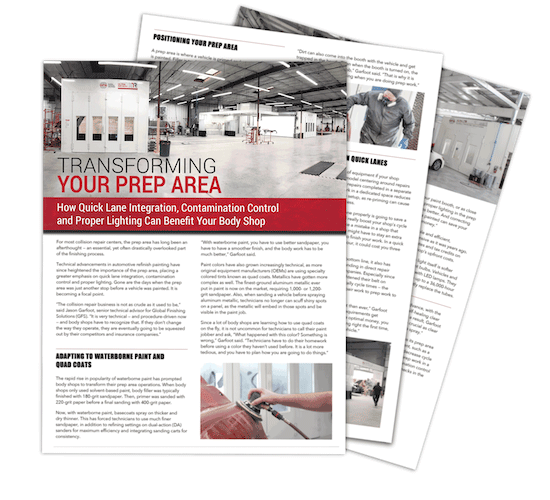
In the seemingly never-ending quest for collision repair shops to be more productive, more profitable and viewed more favorably by customers and insurance companies — reducing cycle times is paramount.
Cycle time is how long it takes to repair a vehicle, from drop off to completion. Numerous variables positively impact cycle times, including accurate damage assessments, streamlined parts ordering and coordinated technician workflows — helping minimize delays and keep repairs moving smoothly through the shop. When cycle times are shorter, shops can repair more vehicles within the same timeframe, allowing them to increase revenue without additional labor.
In addition to appeasing customers who want their damaged vehicles fixed quickly, collision repair shops must place a large emphasis on lower cycle times to meet insurance companies’ direct repair program (DRP) requirements, which are established to lower their overall claims cost. In this FREE guide, discover how shops can reap the benefits of quickened cycle times by ensuring their work in progress (WIP) remains in check and capitalizing on the throughput gains of a new paint booth or accelerated curing system, with boosted efficiency, fewer bottlenecks and higher-quality repair standards.
In this FREE guide, you will learn:
Why repairers who were once anti-direct repair programs (DRPs) are now considering DRP agreements
How optimal cycle times are most easily achieved by shops that most effectively manage their WIP (work in progress)
What aspects of an investment in a new paint booth speed your shop’s cycle times
How a new dual-skin downdraft paint booth can provide significant cost savings from decreased electricity and gas usage
How curing time can be dramatically reduced thanks to the speed and efficiency of mobile shortwave infrared (IR) systems
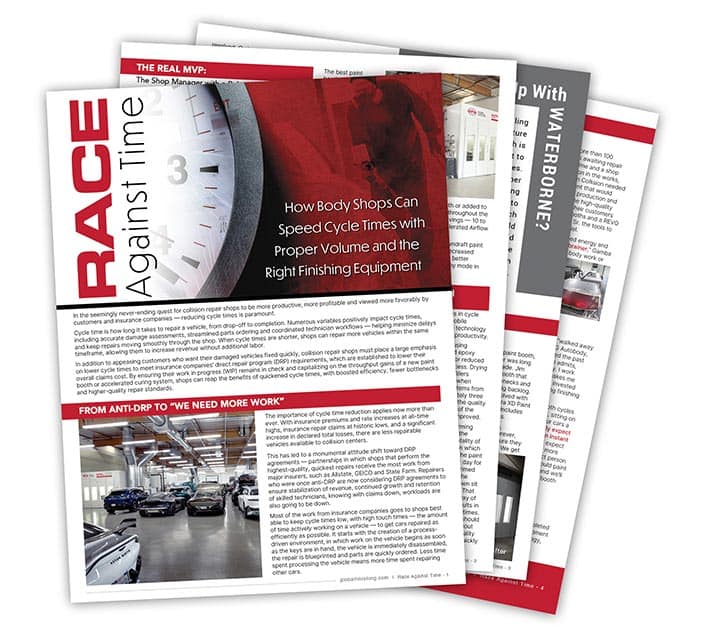
Download your free guide today!
Fill out this form and we’ll send you our free guide on automotive refinish cycle times
How Can My Shop Get More Work From Insurance Companies?
Most of the work from insurance companies goes to collision repair centers best able to keep cycle times low, with high touch times — the amount of time actively working on a vehicle — to get cars repaired as efficiently as possible. It starts with the creation of a process-driven environment, in which work on the vehicle begins as soon as the keys are in hand, the vehicle is immediately disassembled, the repair is blueprinted and parts are quickly ordered. Less time spent processing the vehicle means more time spent repairing other cars.
Discover how to boost your shop’s efficiency, minimize bottlenecks and create higher-quality repair standards. Fill out our request form and we’ll send you our free guide on automotive refinish cycle times.